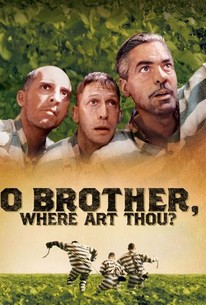
Throughout O Brother, Where Art Thou?, The Coen brothers included various elements in the film that drew inspiration from Homer's The Odyssey. The following are a few of these elements and characters from O Brother, Where Art Thou? that are meant to reference Homer's The Odyssey.
 In The Odyssey, Sirens are seductive creatures who try to tempt the main character of Odysseus into coming with them. To counteract this, Odysseus fills his ears with beeswax and is bound to the mast of his ship as instructed to him by Circe.
In O Brother, Where Art Thou?, the Sirens act like they do in Homer's poem. They're used in the plot as a way to tempt our main characters. However unlike Odysseus in The Odyssey, Elmer, Delmar, and Pete do nothing to protect themselves from the Siren's temptations and allow themselves to be thrown off their path.
In The Odyssey, The creature of the Cyclops is known as Polyphemus, son of Poseidon. In the poem Polyphemus takes Odysseus and his crew members as hostage in his cave. Odysseus is only able to escape from Polyphemus by sneaking away after shoving a hot staff into his eye, blinding him.
O Brother, Where Art Thou?'s interpretation of the Cyclops is with the character Big Dan Teague. Big Dan is portrayed as being physically big and by being slightly blinded with only one eye. In the film's course of events, Big Dan lures the characters of Elmer and Delmar off of their path in order to attack them and rob them. Big Dan also kills the toad which at the time is believed to be the character of Pete at the time, similarly to how Polyphemus kills Odysseus' crew members by eating them.

The Sirens
In O Brother, Where Art Thou?, the Sirens act like they do in Homer's poem. They're used in the plot as a way to tempt our main characters. However unlike Odysseus in The Odyssey, Elmer, Delmar, and Pete do nothing to protect themselves from the Siren's temptations and allow themselves to be thrown off their path.
Big Dan Teague
In The Odyssey, The creature of the Cyclops is known as Polyphemus, son of Poseidon. In the poem Polyphemus takes Odysseus and his crew members as hostage in his cave. Odysseus is only able to escape from Polyphemus by sneaking away after shoving a hot staff into his eye, blinding him.
O Brother, Where Art Thou?'s interpretation of the Cyclops is with the character Big Dan Teague. Big Dan is portrayed as being physically big and by being slightly blinded with only one eye. In the film's course of events, Big Dan lures the characters of Elmer and Delmar off of their path in order to attack them and rob them. Big Dan also kills the toad which at the time is believed to be the character of Pete at the time, similarly to how Polyphemus kills Odysseus' crew members by eating them.
Journey

Both O Brother, Where Art Thou? and The Odyssey share the common theme of a journey. O Brother, Where Art Thou? tells of Elmer, Delmer, and Pete's journey to find "The Treasure". While this physical treasure ends up being false, these characters still travel across the land in order to get to their destination. Similarly in The Odyssey, Odysseus' journey is to return from war back to his home. In his journey Odysseus travels all across Greece in order to reach his goal of returning home.
Comments
Post a Comment